
Serendipity at Work
The Failures, Accidents and Missteps That Changed Everything
Falling Ass-Backwards Into Greatness
April Fools’ Day comes with rules — at least it did when many of us were kids, and they seem to be regional in nature. I’m not sure what it was like where you grew up, but we were taught that the pranks had to conclude at noon, and that anyone who tried to trick you afterward was fair game for the sing‑song reprimand:
“April Fools is gone and past, You’re the biggest fool at last!”
It was a tidy system: the morning’s mischief abandoned in the afternoon. Roguery before lunch, order restored by 12:01.
But the older you get, the more obvious it becomes that the cosmos basically thumbs its nose at this schedule. Some of humanity’s greatest breakthroughs — the discoveries that shaped medicine, technology, food, even humanity — didn’t happen during carefully planned experiments conducted by people wearing safety goggles and taking meticulous notes. They happened in the untidy, unstructured, and decidedly unplanned moments when something went sideways.
And sometimes those detours ended up leading to something great.
When Accidents Become Medical Breakthroughs
Most of us like to imagine that scientific progress is a straight line: a hypothesis, a controlled experiment, a tidy conclusion — lather, rinse, repeat. In reality, some of the most important breakthroughs in human history arrived because someone forgot to clean something or wired something incorrectly.
This section is about the moments when the universe taps a researcher on the shoulder and says, “Yoo-hoo. Over here. Maybe take a look at this.”
And to their credit, they actually notice.
These aren’t stories of persistence or prescience. They’re stories of attention — of people curious enough to ask, “What’s that?” instead of “Uh oh.”
Penicillin — The Mold That Saved Millions
Alexander Fleming didn’t set out to change medicine. He set out to go on vacation.
When he returned to his lab in 1928, he found a petri dish he’d forgotten to clean. It was contaminated with a fuzzy ring of mold. Annoying, yes — but also… odd. The mold seemed to be killing the bacteria around it.
Most researchers would have thrown the dish out and blamed the lab assistant. Fleming leaned in.
The mold was Penicillium notatum, and the clear ring around it was the beginning of the antibiotic era. A global medical revolution started because someone didn’t tidy up before leaving town. And before long, gonorrhea became a little less problematic.
Meanwhile, if I leave a sink full of dirty dishes for four or five days, I’m branded a lazy slob instead of a titan of pharmaceutical science.
Life’s not fair.
X‑Rays — The Glow No One Expected
In 1895, Wilhelm Röntgen was experimenting with cathode rays to see if they could pass through glass when he noticed something strange: in his darkened lab, a fluorescent screen a few feet away was glowing even though his cathode tube was covered in heavy black paper.
He did what any reasonable scientist would do — he turned off all the lights and started waving things around in the dark to see what was causing the glow.
Eventually, he realized it was coming from his cathode ray tube. Somehow, a previously unidentified form of radiation was making it through the paper covering — and, as it turned out, through plenty of other things as well.
Including, as he soon discovered, his wife’s hand, which he placed between the tube and the screen.
The bones of her fingers appeared as a shadowy image on the screen. She reportedly said, “I have seen my death.” Followed immediately, I assume, by: “Why did you use my hand instead of your own? You jerk!”
Röntgen may be credited with discovering X‑rays — but his wife, Anna Bertha Ludwig, definitely gave him a hand. (I’ll see myself out.)
The Implantable Pacemaker — The Wrong Resistor in the Right Place
In 1956, Wilson Greatbatch was building a device to record heart sounds. He reached into a parts bin, grabbed a resistor, and soldered it into place.
But instead of recording anything, his circuit pulsed steadily and rhythmically — lub‑dub, lub‑dub — just like a heartbeat.
Upon closer inspection, he realized he’d picked the wrong resistor. Most engineers would have cursed loudly, torn the circuit apart, and started over. Greatbatch saw an opportunity instead.
He hadn’t built a recorder at all — he’d accidentally built a tiny, low‑power oscillator that he realized could regulate an irregular heartbeat.
Up until then, pacemakers were massive external devices the size of a cereal box, filled with vacuum tubes, and plugged into a wall outlet. Greatbatch’s accidentally engineered circuit paved the way for the first successful, self‑contained implantable pacemaker. He spent the next two years turning his “accident” into a working device.
And just like that, the days of lumbering through your house with a family‑sized box of Count Chocula strapped to your chest and a 75‑foot extension cord dragging behind you were over.
Accidents don’t guarantee breakthroughs. Most of the time, they’re just accidents. But every so often, someone looks twice instead of once. They notice the mold, the glow, the pulse — the thing that shouldn’t be happening — and they follow it.
This section is a reminder that serendipity isn’t luck; it’s when curiosity confronts the unexpected.
And it sets the stage for what happens when the thing you make isn’t the thing you meant to make at all.
When Failures Become Something Else Entirely
Ironically enough, these are the kinds of triumphs that arise from failure — unmitigated, unequivocal, undeniable failure. The kind of failures that, if things go well, get quietly swept into the dustbin of history before anyone else hears about them.
Failures that are definitive? Yes. Disappointing? For sure. Embarrassing? Quite possibly.
But sometimes a spectacular catastrophe becomes a stupendous coup — if someone else is willing to see it differently.
Someone with a different problem or perspective, someone unburdened by what it was supposed to be, looks at your failure and says, “Actually… what if we used it for this instead?”
This section is about the inventions that only existed because the original idea didn’t work.
Post‑It Notes — The Weak Glue That Stuck Around
In 1968, Spencer Silver, a chemist at 3M, set out to create a super‑strong adhesive. Instead, he invented the exact opposite: a weak, low‑tack adhesive that barely held anything at all.
Even a merely strong glue would’ve been a failure when you were trying to invent a super‑strong glue. So imagine how big the failure is when you create the polar opposite of what you set out to achieve. It’s like designing a parka for a winter in Nunavut and ending up with a pair of Speedos.
Still, Silver believed his less‑than‑useless glue had potential — he just couldn’t articulate what that potential was. He spent five years trying to convince anyone at 3M that his failed adhesive — one so ineffective a toddler could peel apart whatever it touched — was useful. He gave internal seminars. He demonstrated it at meetings. He tried to persuade colleagues that a glue that didn’t really glue was somehow valuable. People smiled politely and walked away.
It was 3M’s solution without a problem.
Then in 1974, Art Fry — a colleague who sang in a church choir — needed a bookmark that wouldn’t fall out of his hymnal or damage its pages when removed. He remembered Silver’s “failed” adhesive. He dabbed it onto scraps of paper.
It worked. Perfectly.
Even the signature canary‑yellow colour came by chance — it was simply the only scrap paper the lab next door had on hand for prototypes. What started as a colour of convenience became an iconic visual trademark.
Eventually, a free sampling campaign led to a product launch in 1980, and today, the Post‑It Note — born from reframing the idea that a glue was only useful if it could hold a truck bumper in place — is a flagship 3M product valued at $2.5 billion.
Bubble Wrap — The Wallpaper Nobody Wanted
In 1957, two engineers, Alfred Fielding and Marc Chavannes, sealed two shower curtains together to create a textured, modernist wall covering they hoped would appeal to the up‑and‑coming Beat generation.
It was innovative.
It was bold.
It was also hideous.
Nobody wanted it. Not even the Beatniks.
And when something is so visually repugnant that it can harsh the vibe of a bunch of bongo‑playing hipsters, you know someone on your creative team slipped a cog somewhere.
Fielding and Chavannes tried again — this time pitching it as greenhouse insulation. It was still ugly, but now it had the added benefit of failing completely as insulation.
So they looked at their material in a different way.
It was no longer about décor or energy efficiency.
It was about protection.
In 1961, IBM used Fielding and Chavannes’ invention to safeguard their newest computer during shipment — and the rest, as they say, is history.
Bubble Wrap became the gold standard for packaging worldwide. More than that, it became a source of unbridled happiness for people of all ages who love to pop it — which, let's be honest, is everybody.
It’s a global staple born from two unrelated failures and two guys willing to see the material for what it could be, not what it was supposed to be.
Failures rarely announce themselves as opportunities. They look like dead ends, wasted effort, or the wrong outcome entirely. But every now and then, failure is just success wearing the wrong label — waiting for someone with a different need, a different angle, or a different imagination.
And that brings us to the next kind of serendipity: the moments when you do invent the right thing… but you don’t recognize it at all.
When You Fail to Capitalize on Your Idea
What about when you succeed at the hard part — the idea, the invention, the breakthrough — but fail at recognizing its value? The thing works. The potential is enormous. And the people who created it simply can’t see it. Or can’t be bothered to go the extra kilometre to make it work.
Either way, they walk away.
Leaving it for someone else to pounce on.
This section is about the opportunities that slipped through the fingers of the people who made them — and the ones who picked them up.
Kodak — The Company That Invented the Future and Then Hid It in a Drawer
Remember the urban legend about the guy who invented a car that runs on water, only to have the plans bought and buried by an oil company? This is the same kind of story — except this one actually happened.
In 1975, a young Kodak engineer named Steve Sasson built the world’s first digital camera. It was the size of a toaster, recorded grainy black‑and‑white images, and took 23 seconds to save a single photo to tape — which sounds slow until you remember that with film you had to finish the roll and wait two weeks for the prints to come back in the mail. Twenty‑three seconds was practically light speed.
Sasson proudly demonstrated the prototype to Kodak executives. Their response was deeply corporate: “Cute idea. Now don’t tell anyone about it.”
Kodak fully understood what they had. But when your entire business revolves around film, a camera that doesn’t use any threatens your corporate identity at the molecular level. They knew consumers would leap at the chance to ditch the cost and hassle of film.
So they buried the idea.
And who could blame them? Heading into the 21st century underpinned by a technology invented when Queen Victoria was still posing for portraits like smiling was illegal made perfect business sense. Right?
Of course not. It was delusional
So, while Kodak doubled down on a century-old film-centric business model, rivals like Sony and Canon ran with the digital technology Kodak pioneered. In 1988, Fujifilm released the first consumer digital camera capable of storing photos on a memory card.
The race was on — and Kodak stood still at the start line.
They eventually released their first digital camera in 1995 — twenty years after inventing the technology. But it was too little, too late.
In 2012, Kodak filed for bankruptcy — undone by the very technology it created.
Quaker Oats — The Oatmeal Company That Accidentally Built a Candy Empire (for Someone Else)
In the late 1960s, Quaker Oats was tired of being “the oatmeal company.” They wanted something flashier — not a whole candy division, just one blockbuster chocolate bar.
So they licensed the name “Willy Wonka,” acquired the rights to Charlie and the Chocolate Factory from Roald Dahl, and then bankrolled a movie adaptation of the book.
Now, to be clear, the movie wasn’t being made for artistic reasons. It wasn’t being made to bring a beloved children’s story to the big screen and enrich the cultural landscape. Quaker made Willy Wonka & the Chocolate Factory as nothing more than a 100‑minute commercial for their newly released Wonka Bar.
But the chocolate bars had production issues — they melted far too easily in storage and transit. They were pulled from store shelves almost immediately, before the movie meant to promote them even premiered.
Oh, and the movie itself was a box office bomb.
Quaker had spent millions producing a feature film as an advertisement for a product that wouldn't exist by the time anyone watched the film. It was a corporate disaster of epic proportions.
Eventually, Quaker let the movie rights go, and the candy rights changed hands a few times after that — leaving them completely out of the Wonka business.
And then something strange — and, if you’ve been paying attention, not entirely surprising — happened.
By the 1980s, television re‑airings and home‑video popularity had turned the movie into a beloved family classic. In 2014, the US Library of Congress selected it for preservation in the National Film Registry.
And the Wonka brand, purchased by Nestlé, became a confectionery empire valued at hundreds of millions of dollars.
Quaker did all the work — the licensing, the funding, the production. And they got none of the long-term payoff. Leaving someone else to reap the rewards of their investment, their vision, their effort.
Sometimes you don’t just miss the opportunity — you hand it to someone else with a bow on it.
And Quaker, for what it’s worth, decided that if oatmeal was going to be boring, they might as well lean into it by hiring Wilford Brimley as their spokesman. Because a curmudgeonly, walrus‑moustached, balding man who looked 20 years older than he actually was — hectoring you to eat your oat bran — really did feel like “the right thing to do.”
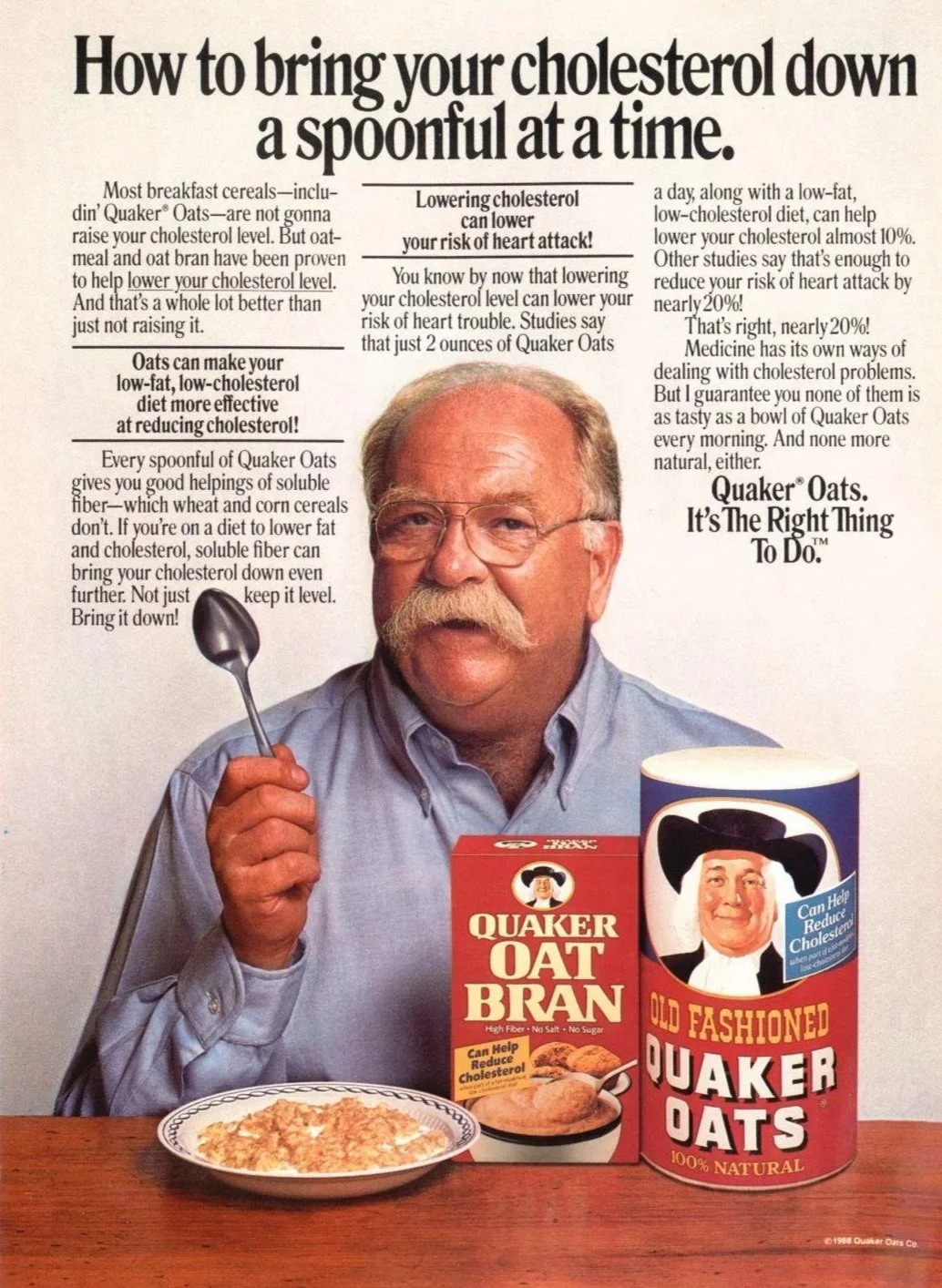
Wilford Brimley, age 54. Oat bran may be good for your health, but this photo did wonders for my self‑esteem.
These stories aren’t about failure — they’re about corporate myopia.
The invention worked. The idea was sound. The potential was real. But the people closest to it either couldn’t see what they had or couldn’t be bothered to pursue it.
The success didn’t come from a better idea — just from someone with a different viewpoint, someone completely outside the original invention.
History is full of incidents and accidents — but the ones that matter most don’t change the invention, or the company, or the industry…
but the person.
When Mistakes Become Milestones
Some mistakes don’t just lead to clever inventions; they tilt the axis of an entire field of study.
Or in Alfred Nobel’s case, six of them.
This is the story of an accident so unsettling it made one man rewrite his legacy — and, in the process, etch his name onto the cultural and scientific landscape in a way no invention ever could.
Alfred Nobel Reads His Own Obituary (And Doesn't Love the Review)
Alfred Nobel was a Swedish chemist who became famous — and immensely wealthy — for inventing explosives, chief among them dynamite. But when his brother, Ludvig, died in 1888, a French newspaper mistakenly published Alfred’s obituary instead.
Not many of us get the chance to read what the world thinks of us after we’re gone. Personally, I’d rather not have the timeline of my PhD‑level dumbassery printed for public consumption. But that’s just me.
Nobel, however, got that chance — and the review was brutal.
The obituary labeled him a “merchant of death” whose fortune came from creating new and innovative ways to “mutilate and kill.”
Now, I’ve watched a lot of Saturday morning TV and my research confirms that dynamite isn’t deadly at all. Sure, it may turn your face black, your hair (or what’s left of it) will stick straight out like you've been electrocuted, and plumes of smoke will curl skyward from your charred head. But within seconds, the soot vanishes, your coif is restored, and you’re free to resume your pursuit of the roadrunner or rabbit without consequence.
So imagine waking up one morning and discovering that history has graded you the way a smoke detector judges your cooking.
Though Nobel never admitted it publicly, he was allegedly horrified at the prospect of being remembered as someone responsible for mass death and destruction. Horrified enough, in fact, to rewrite his ending — or, more literally, his will. On November 27, 1895, he signed a final testament bequeathing the majority of his estate to establishing prizes for eminence in Chemistry, Literature, Medicine, Physics, and, of course, Peace. (Economics was added later, in 1968.)
It remains one of the most elegant plot twists in the history of public relations.
Celebrate Your Mistakes — They Might Be Your Legacy
April Fools’ Day reminds us that life is full of missteps, misunderstandings, and moments that don’t go according to plan. But history reminds us that some of those moments are the seeds of greatness.
So the next time something goes sideways — the code breaks, the draft collapses, the experiment mutinies — pause before you panic. You might be standing at the threshold of your own accidental masterpiece.
After all, the world’s most iconic adhesive started as a failure. Your next mistake might be the one that finally sticks.
Like what you read? I write, rewrite, overthink, rewrite again, and eventually post these things in hopes they resonate. If something struck a chord, sparked an idea, or — most importantly — made you laugh, please drop a comment below. Sarcasm is welcome, cruelty is not. So be honest, and be nice. It’s possible to do both.
And if you'd like to support the effort (or just bribe me to keep going), you can buy me a coffee. No pressure — but caffeine is a powerful motivator.
Full disclosure: you can’t actually make me buy a coffee with your donation. I might use it for a beer instead.