
Pi Day 2026
Exploring The World’s Most Famous Ratio
Now I Spin A Story Regarding Pi
In 1988, Larry Shaw, a physicist at the San Francisco Exploratorium, founded “Pi Day” on March 14 — chosen because the month and date match the first few digits of pi (3.14).
For many of us, the mathematically inclined and declined alike, March 14 has become a celebration of the strange and wonderful constant known as pi (π). And now, as we prepare to mark its 38th observance, I figured it was time to write about it.
There’s something inherently funny about Pi Day. Not the number itself — although any number that refuses to end, repeats nothing, and governs much of the universe’s geometry is at least mildly amusing. What’s funny is that we, as a species, decided to celebrate it. March 14 rolls around and suddenly everyone becomes an armchair mathematician, proudly rattling off the first three digits of pi with theatrical bravado.
And since pi cannot be expressed as a simple ratio of two integers, it’s also the only day when you can rationally celebrate the irrational.
I know what you’re thinking, and you’re right: Pi Day already has a sizable following. So why am I adding to the cultural noise by writing about it?
Because — as George Mallory put it when asked why he climbed Mount Everest — it’s there.
So today, I’m spinning a story about pi — a number that’s been around since the beginning of time, yet one we’ve only studied for about 4,000 years. There isn’t much we don’t know about pi, and yet it still manages to be more interesting than most of the meetings I’ve attended.
Now, granted, that’s a pretty low bar. In many of those meetings, ennui had me wrestled to the floor in a sleeper hold long before the coffee arrived.
Circle Study And Other Engaging Interests
Let’s start with the basics: pi is the ratio of a circle’s circumference to its diameter. That’s it. That’s the whole thing. A simple relationship between two simple measurements that somehow spirals (pun intended) into an infinite, patternless progression of digits.
The problem is that, no matter the circle you have, you’ll never get exact measurements for both lengths — at any scale. A circle that’s three feet across will be “nine feet and a bit” around; a circle that’s nine feet around will be “almost three feet” across.
And try as you may, no matter how small the unit you use — centimeters, millimeters, nanometers, angstroms, whatever — you’ll never wind up with whole numbers for both the circumference and the diameter of any circle you have, build or can imagine.
Pi has been around for as long as circles have existed, which — according to historians — is “a long frickin’ time.” Ancient civilizations approximated it. Mathematicians began calculating it. And today, modern computers churn out digits to stupefying degrees of accuracy for absolutely no practical purpose whatsoever.
Because when it comes down to it, everything we’ve ever needed from pi’s decimal expansion has been known for about four centuries. (More on this later.)
And yet, Pi Day isn’t really about the math. It’s about the vibe. It’s about the cultural moment when teachers, engineers, office workers, and your cousin who once took a statistics class all come together to say, “Hey, I know a number that starts with 3.14.”
It’s the great equalizer — the one day a year when knowing something about geometry makes you cool.
Or at least… cool‑adjacent.
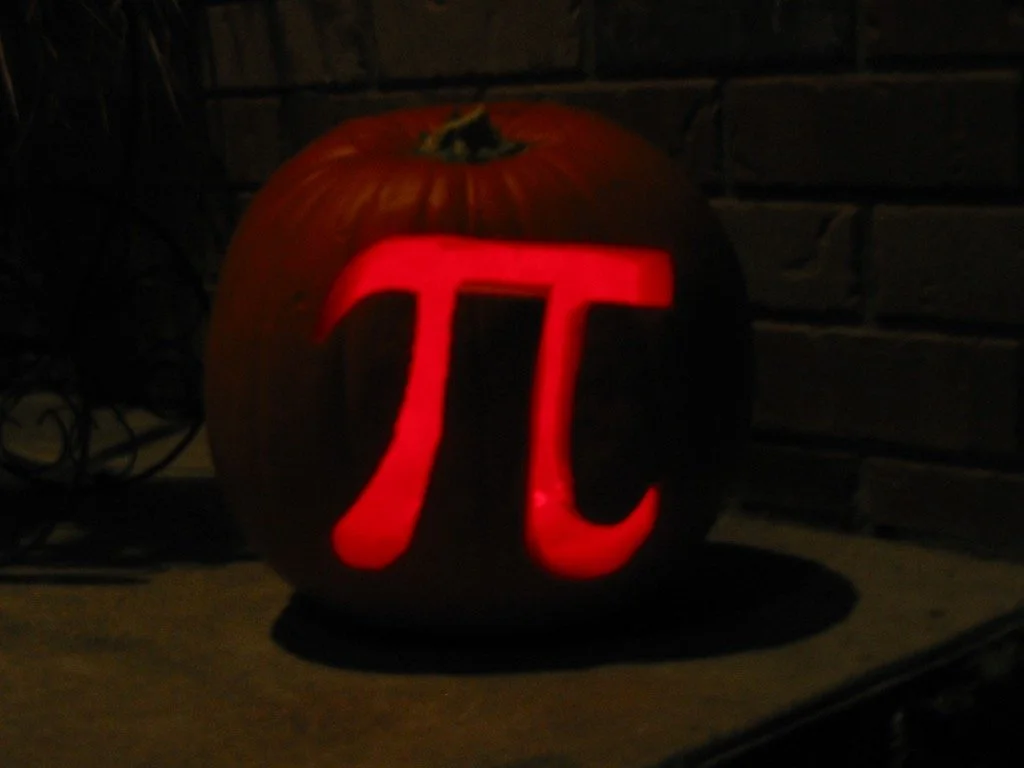
Hallowe’en 2007 - Pumpkin Pi
Young trick‑or‑treaters were confused but curious. The older kids — particularly my wife’s calculus students — steered clear, traumatized by math‑triggered flashbacks and a fear we were handing out calculators instead of sugar.
Decimal Expansion? Big Is Not Required!
If there were ever someone — or a group of someones — who needed an extraordinarily precise approximation of pi, you’d think it would be NASA. After all, these people deal in distances that are, quite literally, light‑years beyond anything we encounter in our everyday, non‑cosmos‑exploring lives.
And yet Marc Rayman, Chief Engineer for Mission Operations and Science at NASA’s Jet Propulsion Lab, admits they “get by” with just the first 15 decimals of pi: 3.141592653589793.
He uses the example of their most distant spacecraft, Voyager I, which is currently about 25 billion kilometres away. If we treat that distance as the radius of a circle, then the diameter would be 50 billion kilometres. The circumference of that circle works out to an enormous distance — over 157 billion kilometres.
Using pi to 16 decimal places, just one more than NASA routinely uses, would change that circumference by about a centimetre.
On a distance of over 157 billion kilometres.
Rayman offers a second example: the circle that describes the visible universe. At an estimated diameter of 93 billion light‑years (or, for those imagining the road trip, 879 billion trillion kilometres — you’ll likely want to use the bathroom before departing), the first 37 decimal places of pi will calculate the universe’s circumference to within the width of a hydrogen atom.
That’s it.
The first thirty‑seven decimals of pi — which we’ve known for almost 400 years — are enough to calculate the circumference of the largest circle in existence to an accuracy within one‑millionth the width of a human hair.
Meanwhile, I need 37 minutes to remember why I walked into a room.
It’s pretty clear that calculating pi to such ridiculous precision — hundreds of trillions of digits at last count — is the mathematical equivalent of using a backhoe to plant a begonia. It’s overkill that’s equal parts pointless and spectacular.
And yet we keep going. We keep calculating pi to more and more digits, as if the universe is suddenly going to say, “Actually, I’m a little bigger now — you might want to tack on a few more decimals.”
But no. Thirty‑seven decimals get you the whole universe. Everything beyond that is just a “nice to have”.
By the way, we will need that 38th decimal place when the universe becomes about ten times bigger than it is now — something that won’t happen for “billions and billions of years,” as Carl Sagan (or at least Johnny Carson’s version of him) might say.
And while I cannot speak for you, my fondness for cookies probably means I’m not going to be around to witness that.
Vast Number Of Digits
We don’t just calculate pi — we compete to calculate pi.
For centuries, mathematicians chipped away at pi with quill, inkwell, and parchment (and later, pencil and paper), adding a few digits at a time. And honestly, given how long it took to squeeze out an extra decimal place or two, the only explanation that makes sense is that the digits weren’t being calculated at all — they were being recovered.
I can practically see some poor British mathematician heaving a chunk of Stonehenge a few inches to the left, jotting down the two or three digits he found hiding underneath, and then schlepping it back into place just to keep the druids from asking questions.
Then computers arrived and said, “Hold my beer,” and suddenly genuine progress was being made — millions, billions, and now even trillions of decimal places coming into view. The advent of computer technology gave the planet’s math community cause to exhale a collective sigh of relief, grateful that they no longer had to risk bodily injury just to make headway.
Which is fortunate, because “underneath the Great Wall of China” was next on their list of hiding places to check.
It’s now become a technological arms race, except instead of missiles or moon shots, the prize is bragging rights over who coaxed the most digits out of a number that literally never ends.
But those bragging rights have been fleeting, at best. Progression has been staggering and doesn’t appear to be slowing down.
Case in point: On April 2, 2025, 300 trillion decimals were calculated by a computer that ran non-stop for 226 days. And just seven and a half months later, on November 18, 2025, the current record of 314 trillion digits were calculated in less than half that time — 110 days.
And, just for context, here’s what 314 trillion decimals actually looks like:
If you could recite 1,000 digits a second, it would take you almost 10,000 years to read that number out loud.
Printed as a standard Word document, it would require nearly 105 billion sheets of paper, creating a stack over 10,000 kilometres high — about 25 times higher than the orbit of the International Space Station — and weighing roughly 475,000 metric tons (the equivalent of about 80,000 African elephants).
Here are just a few of the most interesting pi milestones (or, as I like to call them, “pilestones”) we have achieved over the years:
| Date | Who | Decimal Places | Notes |
|---|---|---|---|
| 2000 BC | Ancient Sumerians, Babylonians, Egyptians | 1 | Over 4,000 years ago, several ancient civilizations determined that pi was about 3.1. |
| 1200 BC | Ancient Chinese | 0 | Meanwhile, 800 years later, the Ancient Chinese had pi set to 3. Slackers. |
| 250 BC | Archimedes | 2 | Archimedes singlehandedly doubles the decimal expansion of pi. Go Archie! |
| 480 | Zu Chongzhi | 7 | Zu Chongzhi discovers the ratio 355/113 as an approximation for pi, accurate to 7 decimals and a record that stood for almost 1,000 years. |
| 1630 | Christoph Grienberger | 38 | Calculated pi to 38 decimals. Since we only need 37 to measure the universe, we probably could’ve stopped here. |
| 1706 | John Machin | 100 | First to break into triple digits. |
| Date | Who | Decimal Places | Notes |
|---|---|---|---|
| 1946 | D. F. Ferguson | 620 | First to use a mechanical device — his desk calculator — to extend pi. |
| September 1949 | — | 2,037 | First computer calculation of pi. ENIAC took 70 hours. |
| May 1973 | — | 1,001,250 | A million digits. |
| 1983 | — | 16,777,206 | First time reaching 10 million digits. |
| January 1987 | — | 134,217,700 | 100 million digits. |
| August 1989 | — | 1,011,196,691 | 1 billion digits. |
| 24 November 2002 | — | 1,241,100,000,000 | 1 trillion digits. |
| 21 March 2022 | — | 100,000,000,000,000 | 100 trillion digits. |
| 18 November 2025 | — | 314,000,000,000,000 | 314 trillion digits — the current record. |
They End Not — Numerals Yet To Uncover
And because we can, we will keep going. Entire research teams have spent countless hours uncovering more and more digits for nothing other than curiosity and laying claim to a mathematical discovery. People search for patterns in the digits — birthdays, phone numbers, suspiciously long strings of sevens, anything that might hint at structure in the chaos.
But there is no structure.
That doesn’t stop us though. We keep looking. We keep calculating. We keep uncovering new digits like archaeologists brushing dust off an infinite fossil.
There’s something beautifully human about pouring enormous effort into something that has no practical purpose beyond “because we can.”
It’s all about discovering the undiscovered — and not something we might find, but something we will. When we search for things like gold, oil, or diamonds, we know exactly what we’re looking for — we’re just not sure where to find it or whether we ever will find it.
With pi, everything is inverted. We know exactly where the next digit will be and exactly how to find it — we just don’t know what we’ll get.
Repeating? Never!
And that’s the magic of pi. It never repeats. It never ends. It never settles down or becomes predictable. It’s the mathematical embodiment of life itself: messy, surprising, occasionally overwhelming, and full of more oddities and possibilities than we’ll ever fully explore.
Finally, here are a few fun pi-related facts for you to let circle around your head:
Pi was originally called quantitas in quam cum multiflicetur diameter, proveniet circumferencia — Medieval Latin for “the quantity which, when the diameter is multiplied by it, yields the circumference”. Simple, elegant and rolls right off the tongue, doesn’t it? Anyway, in 1706 Welsh mathematician William Jones decided his time could better be spent on virtually anything else as opposed to writing this out every time he referenced it, so he proposed that they use the sixteenth letter of the Greek alphabet, pi (π), to denote the ratio instead.
Two of the world’s most famous theoretical physicists have a connection to Pi Day, March 14. Albert Einstein was born on Pi Day in 1879, and Stephen Hawking passed away on Pi Day exactly 139 years later in 2018.
If you square the first five positive integers (1, 2, 3, 4 and 5) you get 1, 4, 9, 16 and 25 — and these numbers correspond to the letters A, D, I, P and Y respectively, which anagram to “PI DAY”.
However, the string of two‑digit numbers that actually spell out “PI DAY” — 1609040125 — doesn’t appear anywhere in the first five billion decimals of pi. Yet the number 123456789 shows up four times.
In spite of pi never repeating nor ending, it has still not been proven that every possible sequence of digits exists somewhere in its decimals. If that ever does get proven, though, it would mean that everything — every number, and everything that can be converted into a number — could be found lurking somewhere in pi’s digits. Every word in the dictionary, the entire works of Shakespeare, even an entertaining version of this article — everything — would be hidden somewhere, just waiting for someone to find it.
Just in case you’re at a cocktail party and find yourself in need of a conversation starter, the 314 trillionth decimal place of pi, calculated just four months ago, is a 9. Give me a like when you eventually become the life of the party.
Chuck Norris knows the last digit of pi.
So, with Pi Day just around the corner, let’s remember that curiosity — even about something as mundane as a circle — is worth celebrating. That there’s joy in the things we may not fully understand and will never fully know. That sometimes the most irrational parts of life — like an irrational number — are the ones that make it interesting.
And if all else fails, you can always celebrate Pi Day the traditional way: tuck into some onion rings, doughnuts, bagels and pies and tell yourself it’s educational.
Like what you read? I write, rewrite, overthink, rewrite again, and eventually post these things in hopes they resonate. If something struck a chord, sparked an idea, or — most importantly — made you laugh, please drop a comment below. Sarcasm is welcome, cruelty is not. So be honest, and be nice. It’s possible to do both.
And if you'd like to support the effort (or just bribe me to keep going), you can buy me a coffee. No pressure — but caffeine is a powerful motivator.
Full disclosure: you can’t actually make me buy a coffee with your donation. I might use it for a beer instead.