
Mythunderstanding
Corporate Myths That Refuse to Die — Multitasking
Congratulations, You’re a Multitasking Genius
Congratulations.
You — yes, you — are a gifted multitasker. A rare specimen. A cognitive marvel. A human Swiss Army knife with opposable thumbs and an oversized cerebral cortex.
At least, that’s what you tell yourself.
I once ate pizza while watching a hockey game on TV.
Does that make me a multitasker?
No. At best, it makes me a man with a remote, a couch, and perilous sodium levels.
And yes, that example is ridiculous — but the sad truth is that if you pick any two things you’ve ever done at the same time, that doesn’t qualify either.
In cognitive science, multitasking means performing two attention‑demanding tasks simultaneously with no performance loss in either one.
Furthermore, this definition means humans cannot do this. None of us.
Which means science went to the trouble of defining a human ability that no human can actually do.
It’s as if Science said to us: “Here is something that you cannot do. At all. Not even a little bit. But if you could, this is what we’d call it.”
But despite decades of evidence to the contrary, the corporate world keeps treating multitasking like a venerated virtue of productivity — a buzzword that refuses to die, no matter how many studies, burned‑out employees, or common‑sense observations we stack on its grave.
And so, here we are — still pretending multitasking is a skill, still putting it in job postings, still bragging about it in résumés, and still treating it like the sacred cow of corporate folklore.
The Annual Rediscovery That Humans Can’t Multitask
Of course, that doesn’t stop us from partaking in the grand delusion we all share: maybe everyone else can’t, but we’re the exception to the rule.
We think we’re the one person who can do two things at once without turning both into a dumpster fire of inadequacy.
Except… the science says otherwise.
Repeatedly.
We’ve known multitasking doesn’t exist since at least the 1990s — yet scientists keep studying it as if it might suddenly appear. To wit:
A 2023 meta‑analysis found that humans don’t multitask at all — they task‑switch, losing time and accuracy with every switch.
A 2024 workplace study found that knowledge workers switch tasks every 3.5 minutes, usually because they interrupt themselves.
A 2025 cognitive‑performance study found that the more confident someone is in their multitasking ability, the worse they actually perform.
And my personal favourite: a 2025 Cognitive Research study found that “multitasking” increases error rates, stress, fatigue, and — somehow — reduces moral awareness.
Yes.
“Multitasking” makes you slightly more unethical.
So the next time a used‑car salesman or politician brags about their multitasking skills, it’ll at least make some sense.
It’s almost impressive, really — no other corporate buzzword has survived this much scientific opposition. Not even “synergy.” Whatever that is.
But the real question is: Why do real, rigorous scientific studies keep trying to find something that’s already been scientifically debunked?
I mean, I get it. We all know there are the proudly uninformed who walk among us — valiantly staving off facts and common sense — insisting the Earth is an enormous hockey puck or that perpetual‑motion machines are being stifled by Big Physics.
But credible science has long said otherwise.
We’ve known for centuries that the Earth is not an enormous hockey puck at all. It is, in fact, a slightly less enormous basketball.
And we’ve also known for just as long that the laws of thermodynamics aren’t optional, negotiable, or something you can turn on and off like a nightlight.
So with the exception of the occasional tinfoil‑hat devotee, no reputable researcher is still running experiments on either one “just to check.”
But multitasking?
Despite being repeatedly, consistently, exhaustively disproven, it’s still being tested — as recently as last year.
You don’t see two guys in lab coats with clipboards standing on a bridge with an anvil, convinced that this might be the moment gravity takes a personal day. And if you do, I suggest contacting local authorities.
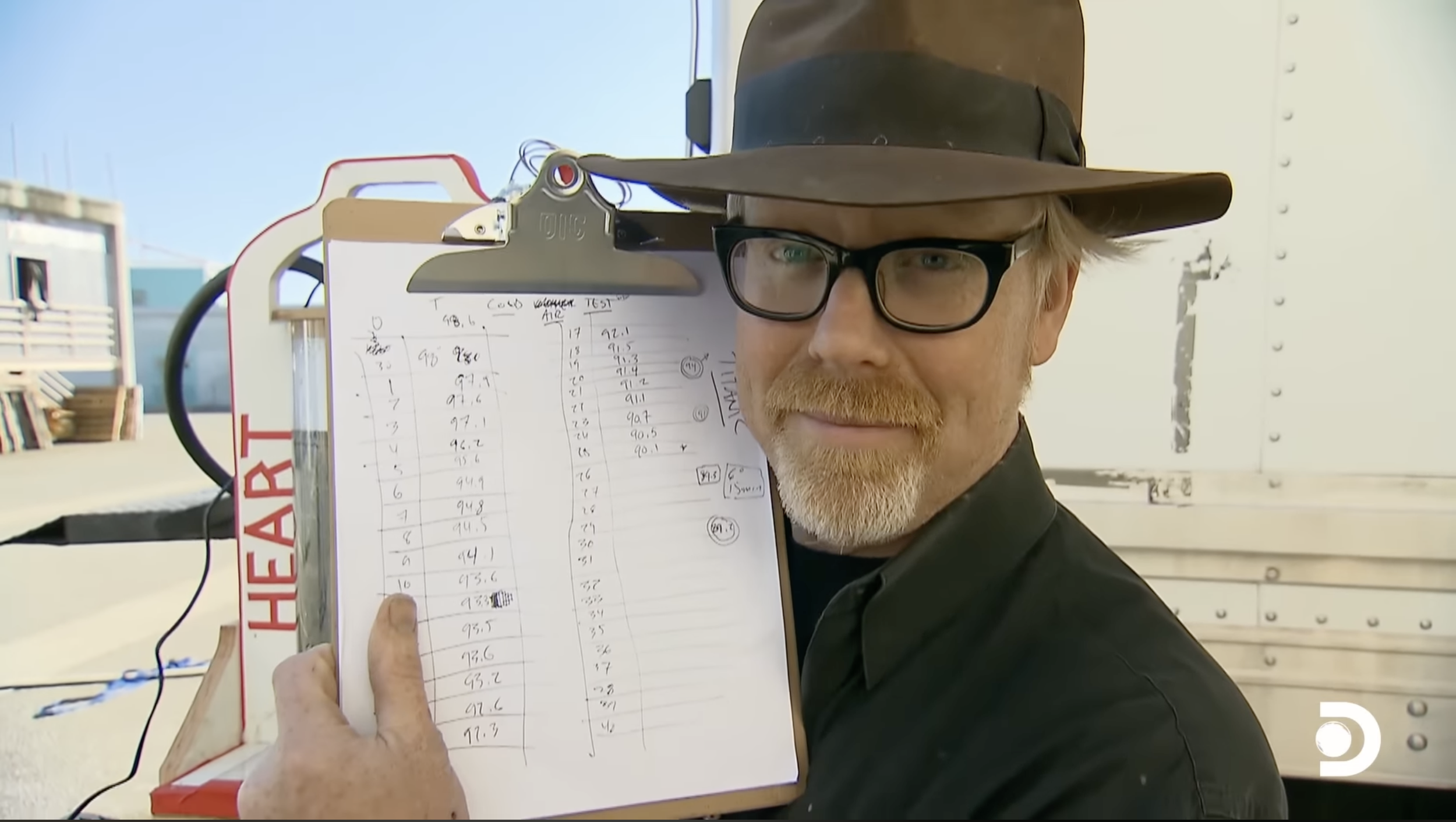
“Remember kids, the only difference between screwing around and science is writing it down.”
— Adam Savage, MythBusters, Season 10, Episode 14 (“Titanic Survival”), originally aired October 7, 2012
And yet, every few years a new study emerges confirming — once again — that humans remain terrible at doing two things at once.
It’s the academic equivalent of publishing a peer‑reviewed paper titled “Fire: Still Hurts Like Hell.”
A Timeline of the Multitasking Myth
1965
IBM invents the word multitasking to describe how a computer could appear to run multiple programs at once.
“Appear” being the operative word.
Because those computers weren’t multitasking.
They were flipping between tasks thousands of times per second — the digital equivalent of a toddler with a bent paper clip sprinting between electrical outlets.
So computers weren’t multitasking.
They were faking it convincingly.
1970s
We co‑opted that same word to describe what we were doing.
Humans thought they were multitasking like computers.
But computers weren’t multitasking.
They were task‑switching.
Which is exactly what humans were doing.
So the irony is that humans believed they were doing what computers were doing, which is true, except that computers weren’t doing what humans thought they were doing — they were doing what humans were actually doing, which humans didn’t think they were doing because they thought they were doing what computers were supposed to be doing, which computers weren’t, and which is really what humans were doing as well.
Turns out we were multitasking exactly like computers were all along — by not multitasking at all.
Crystal clear, obviously.
Late 1980s – Early 1990s
Marketers look at computers “multitasking” and at humans trying to imitate them, and decide people can do it even better — especially if they buy:
a personal digital assistant
a pager
and a smartphone that required a tiny stylus you’d lose three minutes after unboxing it
And we did — to the tune of billions of dollars. Thus begins the Great Human Multitasking Delusion.
2001
IBM finally releases a dual‑core processor — the POWER4 — paving the way for the first computer that can actually multitask.
Today
People walk around with a device in their pocket that contains:
a camera
a flashlight
a calculator
a GPS
a weather station
a music studio
a video editor
the sum of human knowledge
and, allegedly, a phone
…and we still cannot multitask.
Not even a little.
So, to summarize:
In the 60s, IBM invented a word to describe something their computer couldn’t do.
In the 70s, humans adopted that same word to describe something they couldn’t do.
In the 80s and 90s, marketers sold gadgets promising to help people do the thing neither humans nor computers could do.
In the 2000s, IBM finally built a computer that could do the thing they described over 35 years earlier.
And in the 2020s, humans still can’t do it.
The Myth Within The Myth
Now that we’ve covered the history, let’s talk about a corollary of the myth that refuses to die: women are natural multitaskers.
This requires believing not only that multitasking exists, but that women are biologically gifted at it. I think my wife has always secretly believed this, but that’s likely my own fault. I probably didn’t help out “Team Y Chromosome” in the Multitasking Gender Games by routinely falling silent during conversations with her while putting my socks on. I needed to focus, otherwise I’d fall over — even though I’d be sitting down at the time.
The cultural script goes like this:
Men hunted.
Women gathered, raised children, roasted the mastodon, and tidied the cave.
Therefore, women evolved superior multitasking abilities.
It’s a fun story.
It’s also Flintstones fan fiction.
The notion that women are natural multitaskers didn’t come from science — it came from gender roles.
Women were expected to juggle more tasks, so they did. Then culture mistook that workload for a biological advantage.
As more women entered the workforce while still carrying the majority of domestic labour, the myth got reinforced by sitcoms, self‑help books, and every “supermom juggling everything” commercial ever made.
And when real science finally tested the idea?
Every major study found no meaningful difference between men and women — in spite of what every issue of “Women are Awesome, Men are Stupid Quarterly” would have us believe.
So even if multitasking did exist (which it doesn’t), the idea that women have some kind of genetic advantage is also wrong.
What’s actually happening is that women aren’t better at switching — they’re just forced to do more of it. They’re switching between more tasks — faster, more often, and under more pressure — which only looks like multitasking to the untrained male eye… assuming, of course, we were even paying attention in the first place.
If multitasking were truly a biological gift, every mother would be immortalized with a bronze effigy in the town square.
Instead, their brains are bogged down managing a calendar crammed full of school events and extracurricular activities for three kids while their older, fatter, balder kid can’t remember where the scissors are.
What Multitasking Actually Is: Doing Several Things Badly in Rapid Succession
Humans can’t multitask.
We’ve established that.
What we can do is switch between tasks so fast it feels like multitasking — while paying a penalty every single time:
slower work
more mistakes
more stress
and the creeping suspicion you’ve forgotten something important, which you likely have
Your brain isn’t juggling.
It’s flailing.
Task‑switching is basically your prefrontal cortex sprinting back and forth between priorities like a frantic intern who keeps forgetting what room the meeting is in and is still looking for the left‑handed pencil his manager sent him out for two days ago.
And the more you switch, the worse everything gets.
Workplace Multitasking: Productivity Theatre at Its Finest
Despite all this, workplaces still worship multitasking like it’s a productivity superpower.
Job postings demand it.
Because nothing says “forward‑thinking organization” like clinging to a debunked productivity myth from the late ’90s.
Managers praise it.
And employees brag about it.
In fact, employers love multitasking so much they’ve turned it into a corporate spirit animal — a majestic creature that gracefully pivots between twelve priorities while smiling, staying positive, and thriving in a “dynamic, fast‑paced, paradigm-shifting environment.”
So I checked how often this fantasy appears in real job postings.
Out of roughly 527,000 Canadian listings on indeed.com, more than 11,000 explicitly demanded “multitasking.”
That’s just over 2%.
Which is acceptable as a milk option, but it’s an unconscionable prerequisite rate for a skill that doesn’t exist.
If 2% of job postings required applicants to breathe underwater, we wouldn’t shrug and say, “Well, at least it’s not 25%.”
We’d be asking why employers are advertising thousands of jobs for scuba divers and mermaids.
And the delusion is symmetrical.
Applicants see “multitasking” in a posting and confidently put it on their résumé because they once stirred a pot of macaroni while opening a can of tuna.
It’s corporate Darwinism in reverse — the trait that survives is the one that doesn’t exist.
I searched public Canadian résumés — specifically PDF résumés on .ca domains — and even in that tiny slice, hundreds proudly contained the word “multitask.”
Employers demand a skill that doesn’t exist, and applicants confidently claim they have it.
It’s a perfectly balanced ecosystem of mutually reinforced bogusness.
Bogusity?
Bogusitude?
Bogusonomy?
Anyway… you know what I mean.
Everyday “Multitasking” That Doesn’t Count
Here are some examples of me doing two things at the same time — along with the end result — that offer proof positive that I’m not a multitasker:
Being pleasant to a Starbucks barista while accepting my latte. Said “You too!” when they told me to enjoy my drink.
Reheated leftovers while doomscrolling. Cold supper in the microwave two hours later.
Brushed my teeth while walking around the house. Tripped like a klutz, gagged on the toothbrush.
Walked the dog while drinking coffee. Took a sip at the exact instant he saw a squirrel. First‑degree burns.
Ate pizza while watching hockey. Yelled at the ref, choked on a mushroom.
These aren’t examples of multitasking.
But corporate culture has convinced us these tiny life‑admin combos are proof we’re “natural multitaskers,” instead of what they actually are: basic human functioning.
Or, in my case, basic human dysfunctioning.
The Case for Single‑Tasking
Here’s a radical idea: Try doing just one thing at a time.
Not because it’s virtuous or mindful.
But because it’s the only way to produce work that doesn’t look like it was created by a three‑year‑old hopped up on Skittles wielding a box of half-eaten crayons.
Single‑tasking:
reduces stress
improves accuracy
shortens work time
The hardest part of single‑tasking isn’t doing one thing at a time.
It’s defending the one thing you’re trying to do.
Because the corporate myth of multitasking has trained everyone to believe their urgency outranks your focus.
Most of us don’t want six different tasks bouncing around in our heads.
But that’s exactly what happens when someone else shows up with a crisis they’ve decided is now our problem.
We’ve all seen it before: someone appears in your doorway with a financial report that’s out of balance by eleven cents.
On a total of $288 million.
No matter, they’ve been “working on it all morning” and they need you to drop everything and fix it.
Immediately.
Because the fate of the company apparently hinges on a dime and a penny.
So you do it.
You stop what you’re doing.
You spend two or three days tracking it down.
Not because it’s the right priority — but because helping them feels like the right road to take.
But the truth is that the thing you dropped?
It doesn’t disappear.
It’s still there, running laps in the back of your mind.
And it’s not like you don’t think about it, because you have to. Every so often you glance over at it, just to make sure it hasn’t collapsed from exhaustion.
And still it dutifully runs in circles, waiting patiently for you to wave it in so it can come off the track and you can pick up where you left off.
Most “urgent” requests aren’t urgent.
They’re just loud.
If you don’t need to do the new thing right now, don’t.
Listen politely.
Acknowledge the issue.
Then say, “I’ll get to it when I get to it.”
I used to ask people if they’d quit breathing if I didn’t drop everything to help them.
It usually brought clarity to their priorities — sometimes even eliciting a smile — though one person did hold their breath, which, honestly, only strengthened my point.
So yes, single‑tasking isn’t easy.
But you know what else single-tasking isn’t?
It isn’t a lifestyle.
And it isn’t a philosophy.
It’s just how brains work.
Closing: The Permission Slip
You’re not a machine.
You’re not meant to run parallel processes.
You’re barely meant to run one at a time — and that’s fine.
If you want to improve your productivity, do one thing at a time but do it really well. Give it the focus, diligence, and energy it deserves.
Your brain deserves a fair shot at producing your best work.
Remember, you’re not failing at multitasking — because you can’t fail at something that can’t be done.
You’re simply refusing to participate in a corporate myth that should’ve been retired around the same time as dial‑up internet.
You don’t have to keep performing the multitasking fantasy.
You don’t have to pretend the buzzword is real.
You’re allowed to work the way human brains actually work.
Sources
2023 meta‑analysis on task switching, Journal of Experimental Psychology
2024 workplace study on task interruption, Workplace Behaviour Quarterly
2025 cognitive‑performance study, Cognitive Performance Review
2025 study on multitasking and moral awareness, Cognitive Research
Like what you read? I write, rewrite, overthink, rewrite again, and eventually post these things in hopes they resonate. If something struck a chord, sparked an idea, or — most importantly — made you laugh, please drop a comment below. Sarcasm is welcome, cruelty is not. So be honest, and be nice. It’s possible to do both.
And if you'd like to support the effort (or just bribe me to keep going), you can buy me a coffee. No pressure — but caffeine is a powerful motivator.
Full disclosure: you can’t actually make me buy a coffee with your donation. I might use it for a beer instead.