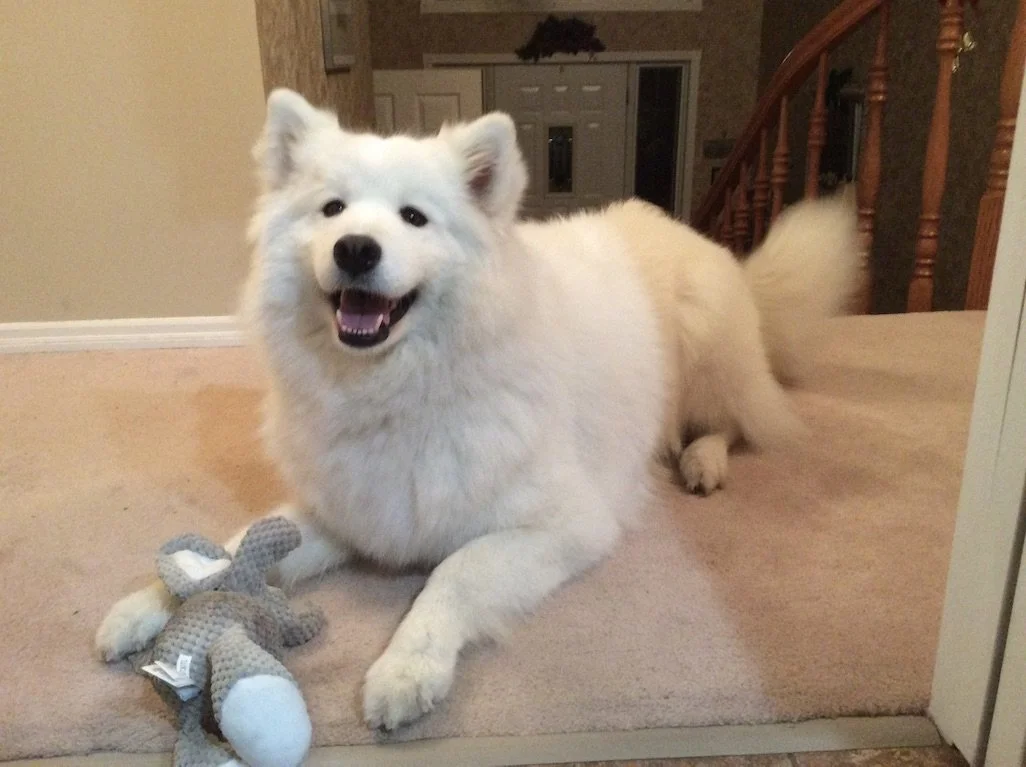
For A Dog
The Day Our House Changed
I knew Wednesday would be her last day.
I was the one who made the call.
I was the one who took the appointment.
I was the one who decided that the dog who had trusted me for ten years would die on a date I chose.
I keep replaying that moment — the phone in my hand, the quiet of the house, the way I told myself I couldn’t take two more weeks of watching her decline — and I don’t know how to forgive myself for it.
I didn’t choose Wednesday because I didn’t love her. I chose it because I did.
But love doesn’t feel like love right now.
It feels like guilt. It feels like betrayal.
And then came the moment I can’t unsee: standing in a vet’s office, holding the body of a dog who depended on me, who trusted me. Her face turned toward my wife and daughter instead of me. I couldn’t even look into her eyes to reassure her — not because I didn’t want to, but because I was trying to cradle her so the vet could do his job.
I was supposed to protect her. But I let it happen. I watched. And I did nothing to stop it.
Nothing in my life had prepared me for the moment when love and harm would feel indistinguishable.
And I don’t know how to make sense of that.
The Last Car Ride
I keep going back to the car ride. It shouldn’t matter as much as it does — but it does. Coco lay in the back seat the way she always did, next to my wife. Cash was with us too — harnessed into the back of the vehicle, curious and oblivious, thinking it was just another outing. He didn’t interact with her much; he couldn’t, not from where he was. To him, it was an ordinary day. To Coco, too.
And all I could think was that she probably thought we were going home afterward. Just another drive. Just another trip out and about. Just another day with her people.
But I knew.
And she didn’t.
And that difference is tearing me apart.
I can’t shake it.
When we got to the vet, I went inside to check in. I stood there waiting for the room to be ready, and after a few moments it was.
I went out to get them and saw my daughter with Cash, leading him by his harness, while my wife had taken Coco for a walk.
There they were. My wife holding the leash. Coco sniffing the ground. Cash pulling at his harness, still full of energy, still unaware of the weight of the moment.
A tiny moment of normal life happening outside the building where everything was about to end.
It felt wrong.
It felt cruel.
I was watching her enjoy something for the last time, and she had no idea.
The room was ready. It was time.
I picked her up. I can still feel the weight of her body in my arms. She didn’t resist. She didn’t struggle. She just let me carry her, trusting me the way she always had.
I walked her into the room and set her down on the tile floor. She struggled to stand, the tile being slippery and her legs being weak. We got her to settle and had a few minutes alone with her. She was probably waiting for the next familiar thing to happen — the car door opening, the house door opening, the smell of our home, the routine continuing.
But the routine wasn’t continuing.
I had broken it.
I had chosen the day it would end.
Then came the part I can’t stop replaying: lifting her onto the table. Steadying her while the vet shaved a patch of fur from her leg. The sound of the clippers. The way she looked around, confused but calm, because she trusted us. Because she didn’t know.
And then the needle.
Not the kind that helps or heals.
The kind that ends.
I remember thinking, She doesn’t understand. She thinks she’s coming home with us. And then the drug went in, and she made a sound I had never heard before — a howl that came from somewhere deep inside her. A sound that didn’t belong in that room. A sound that still hasn’t left my head. It sounded like pain or fear.
The vet later assured us it wasn’t either of those things, but that didn’t matter to me — then or now.
All I could do — all I did do — was quietly repeat, “It’s going to be okay, sweetie… everything will be alright… we’re all right here with you…” trying to keep my voice steady (and failing), trying to comfort her (and failing there too).
And then she was gone.
Just like that.
A sound, a breath, a stillness.
Her body going limp in my arms.
I keep replaying it because I don’t know how to make sense of it. I don’t know how to reconcile the dog who trusted me with the man who stood there and let it happen. I don’t know how to carry the thought that she didn’t understand why her last moments felt like that.
I don’t know how to forgive myself for any of it.
The Long Decline
It didn’t happen all at once. It never does. It was slow, almost invisible at first — small changes that didn’t feel like changes until they were all that was left.
It started when she became less confident with stairs. No problem going down — from the kitchen outside to the balcony, down to the deck, and a couple more to the backyard. But coming up became harder. Then harder still. Then nearly impossible.
So she stayed in the entrance — the loneliest part of the house — while the rest of us lived upstairs. I told myself it was safer for her. I told myself she didn’t mind.
Then she started waking up during the night. She started pacing in circles. We blocked off the staircase to the basement so she wouldn’t fall. With her sight all but gone, sometimes I’d find her standing still, staring at a wall or the laundry room door, as if she’d forgotten what she was doing or where she was.
I remember getting up with her at 2 or 3 in the morning. And sometimes, no matter what I did or tried, I couldn’t get her to settle. She’d lie down for two or three minutes, then stubbornly struggle back up to her feet and start pacing again, wandering the house in a restless loop I couldn’t break. I’d stay up with her, half asleep, trying to guide her, trying to soothe her, trying to understand what she needed. But I never really knew. I don’t think she knew either.
Once, I took her out for a walk at 4:30 in the morning.
Not because she wanted to go outside, but because I didn’t know what else to do. She’d stand by the door, confused, waiting for something to make sense. And I’d put on my shoes and take her out into the dark, hoping it would help, hoping it would settle her, hoping it would give her some kind of comfort.
It didn’t.
Not really.
But I kept doing it because I had no other way to help her.
Her world was shrinking.
Her confidence was slipping away.
I was tired. I was overwhelmed. I was trying to function, trying to work, trying to keep moving through the days as best I could.
She was declining.
She was confused.
She was fading.
And I was breaking.
By the time Wednesday came, I wasn’t choosing between two good options.
I was choosing between two impossible ones.
And I’m still trying to understand how to carry that.
The Last Times I Didn’t Know Were Last Times
I keep trying to remember the last time I took her to the dog park. I know it happened. I know we went. I know she trotted along beside me with that slow, determined gait she had in her later years. But I can’t place it. I can’t see it. I can’t pull it into focus no matter how hard I try.
And that’s what’s breaking me.
I remember the last things I knew were last.
The last photo.
The last car ride.
The last breath.
But the real lasts — the ones that slipped past me — those are gone.
I don’t remember the last time she climbed the stairs to be with us. One day she could. Then one day she couldn’t. And I didn’t mark the moment in between. I didn’t know it was the final time she’d ever curl up near us while we watched TV or worked or just existed in the same room.
I don’t remember the last time she lifted her head when I walked into the room with that spark of recognition she used to have. I don’t remember the last time she nudged my hand for attention. I don’t remember the last time she barked at the door to welcome a visitor or trotted over for a treat or did any of the small things that made her her.
I don’t remember the last time she rode in the car with excitement instead of confusion.
I don’t remember the last time she wasn’t struggling.
And I hate that.
I hate that the endings I should have cherished were the ones I didn’t even notice.
But that’s not how endings work.
They don’t announce themselves. They don’t warn you. They don’t give you a chance to prepare.
They just happen.
And you only realize what they were when they’re already gone.
Now I’m left trying to gather whatever pieces I can — the fragments that surface, the moments that return on their own, the memories that refuse to stay sharp no matter how tightly I try to hold them.
I keep telling myself that forgetting the last times doesn’t mean they didn’t matter.
I know it doesn’t mean I didn’t love her.
Grief does this. It turns ordinary moments into regrets.
And I’m still grieving the moments I didn’t know to hold onto.
The Empty House
The house felt wrong the moment we walked back inside.
It felt too quiet.
Too still.
Too empty.
Her absence was louder than her presence ever was.
I keep replaying the moment I picked up the phone.
The moment I made the appointment.
The moment I told myself I couldn’t keep watching her decline.
I keep replaying Wednesday, the day we took her in.
I keep replaying the car ride.
I keep replaying the walk outside the vet’s office.
I keep replaying the sound she made.
I keep replaying the way her body went limp.
I keep replaying the way I failed her.
I keep replaying all of it.
And I don’t know how to stop.
I don’t know how to forgive myself.
I don’t know how to live in this house without her.
Every room feels wrong.
Every routine feels broken.
Every quiet moment feels like a punishment.
I keep thinking I should have done more.
I keep thinking I should have waited.
I keep thinking I should have tried harder.
I keep thinking I should have known.
I keep thinking I should’ve been better.
I keep thinking I should have saved her.
But I didn’t.
And I can’t change that.
And I don’t know how to reconcile any of it..
The Fear I Still Can’t Shake
There’s something else I keep circling back to, something I haven’t said out loud until now because it hurts in a different way. It’s not about Wednesday. It’s not about the decline. It’s not even about the last times I didn’t know were last times.
It’s about the moments in between.
The moments when I was tired.
The moments when I was frustrated.
The moments when I didn’t know what to do.
The moments when I felt overwhelmed and helpless and stretched thin.
And the thought that she might have felt like she was a burden crushes me.
That thought breaks me in a way nothing else does.
I’ve been told dogs don’t think like that. That they don’t interpret frustration as rejection. That they don’t assign meaning to our tone or our fatigue. That they don’t feel like burdens. That they don’t carry guilt.
I want to believe that.
I try to believe that.
But grief has a way of twisting even the gentlest truths into knives.
When I look back honestly — not through guilt but through memory — I know what she actually experienced.
She experienced my presence.
My hands guiding her.
My voice talking to her.
My footsteps beside her at 4:30 a.m.
My body getting up again and again.
My care.
My effort.
My love.
Even when I was tired.
Even when I was frustrated.
Even when I didn’t know what to do.
She didn’t feel like a burden.
She felt loved.
She felt safe.
She felt protected.
She felt held.
And the fact that I’m terrified she might have felt anything less is proof of how much she meant to me, not proof that she ever felt unwanted.
But this fear is part of the grief.
And I’m still trying to trust that she never felt anything but loved.
The Part I Can’t Escape
Grief has many faces, but mine keeps turning into guilt. Not one kind of guilt. Not a single, sharp point. But a whole landscape of it. A terrain I keep stumbling through and getting lost in. A place where every memory has an edge.
There’s the guilt of making the call.
Of hearing my own voice schedule something that should never be scheduled.
Of feeling like I crossed a line I can’t uncross.
There’s the guilt of making the decision.
Of choosing the day.
Of setting a time for a life to end.
And then there’s the guilt of allowing it to happen and doing nothing to stop it.
Standing there.
Holding her.
Watching the vet prepare the needle.
Watching the moment unfold as if I were a bystander instead of the person who was supposed to protect her.
There’s the guilt of failing to help her when she needed me the most.
The nights she paced.
The mornings she stood by the door, confused.
The times I didn’t know what she needed.
The times I tried and failed.
The times I didn’t try hard enough.
The times I was too tired to try at all.
There’s the guilt of not spending enough time with her.
Of being upstairs while she was downstairs.
Of telling myself I’d sit with her later.
Of letting “later” run out.
There’s the guilt of the moments when I’m not sad.
The moments when I catch myself laughing at something, or feeling okay for a minute, or getting absorbed in work, or simply breathing without thinking about her — and suddenly it hits me like a punch: What are you doing? You don’t get to feel normal. You don’t get to feel anything but devastated.
As if feeling anything other than heartbreak means I’m forgetting her.
As if a moment of relief is a betrayal.
And then there’s the guilt of grieving her while others have experienced losses I can’t imagine.
The guilt of feeling this broken over a dog — a dog — when people lose children, siblings, spouses.
The guilt of thinking my grief doesn’t measure up.
The guilt of feeling it anyway.
And then there are the smaller guilts, the ones that don’t seem like they should matter but somehow matter the most.
I keep thinking about the nights she paced and I slept, the mornings I hesitated before getting up, the moments I sighed because I was exhausted.
I keep thinking about the times I wished, just for a second, that things were easier.
And now all of those moments feel enormous.
They feel unforgivable.
They feel like failures.
It takes every ordinary moment and turns it into a regret.
It takes every hesitation and turns it into a betrayal.
It takes every human limitation and turns it into a moral failing.
And I don’t know how to argue with it yet.
I keep thinking about the entrance — the loneliest part of the house — and how she spent so much time there.
I keep thinking about how I wasn’t down there with her as much as I should have been.
I keep thinking she must have wondered why she wasn’t with us.
I keep thinking she must have felt left behind.
I keep thinking she must have felt alone.
I know she didn’t think that way — didn’t assign meaning to any of it, didn’t feel abandoned.
But I can’t stop imagining that she did.
And that’s the part that’s eating me alive.
Because I loved her.
I loved her the whole way through.
I loved her even when I was tired.
I loved her even when I was frustrated.
I loved her even when I didn’t know what to do.
I loved her even when I wasn’t the version of myself I wanted to be for her.
I hope I didn’t fail her.
But it sure feels like I did.
It feels like every moment I wasn’t with her was a mistake.
It feels like every night I slept while she paced was abandonment.
It feels like every time I hesitated was a betrayal.
It feels like every ordinary day was something I should have cherished.
It feels like love should have been enough to save her.
And it wasn’t.
And I still don’t know how to carry that.
This is the shape of my guilt.
This is the weight I’m carrying.
This is the part of the story I cannot escape.
The Dog She Was
I keep thinking about the way she’d bark when I was talking to someone else, as if she needed to add her opinion. She wasn’t trying to interrupt, she just wanted to be included. She always wanted to be part of whatever was happening, even if it was just a single bark to say, I’m here too.
I keep thinking about the way she’d sit in the passenger seat beside me, looking past me out the driver’s-side window, waiting for the moment the drive‑thru worker leaned out and said, “And a TimBit for your friend?” And there was one girl who would routinely give me four instead of one because she thought Coco was extra‑special. She always knew it was coming. She always waited for it. That tiny donut hole was her ritual, her reward, her joy — the highlight of every coffee run.
I keep thinking about the way she’d trot around the yard with the ball I’d thrown, refusing to bring it back, daring me to chase her. Fetch was never fetch with her. It was keep‑away, and she always won.
I keep thinking about the way she’d crunch down a treat, loud and satisfied, like she wanted the whole house to hear how good it was. Sometimes I’d give her one just to hear that sound.
I keep thinking about the way she’d nudge my hand if I stopped scratching her, reminding me — firmly, insistently — that my job wasn’t finished. She didn’t demand affection so much as assume it was her right.
I keep thinking about the way she’d settle into the car for any trip, long or short, as if the destination didn’t matter at all. What mattered was that she was coming with us. She was happiest when she was part of the journey.
I keep thinking about the way she’d lie in her favourite spot in the backyard while I mowed the lawn — moving only when she absolutely had to, then returning to the exact same place once I’d passed. She supervised the yard like it belonged to her.
I keep thinking about the nights she’d come into our room just before a thunderstorm rolled in. She hated loud noises. We’d bring her into bed with us and do our best to comfort her while the sky cracked open outside. Sometimes we were more successful than others. But those moments were just another reminder that she needed to be close to us — and that being close was enough.
I keep thinking about the way she’d look at me when I said her name. Not excited. Not frantic. Just connected. Just present. Just there.
I keep thinking about the way she’d sigh — that long, slow exhale that sounded like contentment, like trust, like home.
These are the pieces of her that keep rising to the surface.
These are the moments that made her who she was.
This is the dog she was.
The Dog She Became
She didn’t become a different dog.
She became an older version of herself — slower, softer, more fragile, but still unmistakably Coco.
She still wanted to be near us.
She still listened for our footsteps, even though it was harder for her to hear them.
She still lifted her head when she heard my voice, even when it took more effort than it used to.
But her body began to betray her.
Not all at once — in pieces.
The pacing started.
The confusion.
The nights when she couldn’t settle.
The moments when she stood by the door, waiting for something she couldn’t name.
She became a dog who needed help with things she used to do without thinking.
Getting up.
Lying down.
Finding her way around corners.
Remembering where she was.
She became a dog who slept more deeply but woke more easily, startled for reasons she couldn’t understand.
She became a dog who waited for us in the entrance — the loneliest part of the house — not because she wanted to be alone, but because that tiny part of the house became her world. I told myself she didn’t mind. I told myself she was comfortable there. But now I know she was simply doing her best with the world she had left.
We’d still go for walks — as far as I thought she could manage. The snow and ice of winter made it hard for her to keep her balance, so we kept them short. When spring finally came, I’d take her into the front yard, sit on the lawn, and let her wander wide circles around me, her nose to the ground because smell was all she had left.
She became a dog who needed reassurance.
A hand on her back.
A voice saying her name.
A reminder that she wasn’t lost.
But she also became gentler.
More patient.
More trusting.
She relied on us more.
She let us guide her.
She let us lift her when she couldn’t lift herself.
She still loved car rides, even when she couldn’t jump in on her own.
She still recognized the drive‑thru window.
She still waited for her TimBit — the one ritual that never stopped making sense to her — though even that began to fade.
She became a dog who tried — every day — to keep being herself.
And that’s the part that breaks me.
Because even as her world got smaller, she kept reaching for us.
Even as her body failed her, she kept trying to stay connected.
Even as she became confused, she still trusted us to help her find her way.
She didn’t stop being Coco.
She just became a Coco who needed more from us than she ever had before.
And we tried.
We tried so hard.
This was the dog she became.
Not less than she was — just different.
Just older.
Just more fragile.
And more ours than ever.
What Comes Next
I don’t know what to do with any of this. I don’t know how to carry it, or how to set it down, or how to make sense of the shape my life has taken without her. I keep trying to tell myself that I did the best I could, that she knew I loved her the whole way through, that she felt safe and held and cared for — but the guilt keeps arguing with me, louder than reason, louder than memory.
I miss her.
I miss her in ways I don’t have language for.
I miss the sound of her nails on the floor.
I miss the weight of her head on my knee at the supper table.
I miss the quiet comfort of knowing she was somewhere in the house, just being Coco.
I’m writing all of this because I don’t know what else to do. Because the grief is too big to hold. Because the only way I know how to survive it is to put it somewhere outside myself for a little while.
I know this isn’t the end of anything.
I know I’m still at the beginning.
I know I’ll be carrying her — the guilt, the love, the memories — for a long time.
But this is where I am right now.
This is the truth of these first days.
This is the version of me that’s still trying to understand how a house can feel so full of her and so empty without her.
And I don’t know what comes next.
A Note From September
What you’ve just read was written in the first three days after Coco died — when everything was still raw and unbearable. I’m writing this now in late September, just before publishing, with a little more distance and a slightly steadier heart.
A lot of what I wrote back then still feels true. Some of it hurts less than it did. Some of it hurts in new ways. Some of the guilt has softened around the edges. Some of it still ambushes me from out of nowhere.
Just yesterday, as I went through the drive-thru to get my morning coffee, the Tim’s employee reaching for the plain TimBits they keep at the window looked over and, seeing only Cash, asked, “Just the one pup with you this morning?”
“Yes,” I replied. “Just the one.”
I’m not sure I’ll ever fully get past what happened and the part I played in it. But I can see now that the man who wrote those first pages was doing the best he could with a grief he didn’t know how to hold.
Coco came into our lives as a four-year-old retired show dog. We only had her for nine and a half years. She had us for the rest of her life.
When she was with us, those years became such a huge part of our lives. But now every day that passes without her makes those years a little smaller by comparison. The time we had with her never changes. Our lives just keep getting longer without her.
I hate that.
I still miss her. But the memories have started to come back. The good ones, the loud ones, the stubborn ones, the joyful ones. The dog she was has begun to outweigh the way she left.
Yesterday, September 21, would’ve been her 14th birthday. I needed to tell the story the way it unfolded in May, and I needed time to understand what those days meant. Somehow, the timing feels right — a small way of honouring her, a small way of saying she’s still here in the ways that matter.
Happy birthday, Coco.